
Spatially Resolved Observation of Ferroelectric-to-Paraelectric Phase Transition in a Two-Dimensional Halide Perovskite

Signatures of longitudinal spin pumping in a magnetic phase transition
abstract : A particle current generated by pumping in the absence of gradients in potential energy, density or temperature is associated with non-trivial dynamics. A representative example is charge pumping that is associated with the quantum Hall effect and the quantum anomalous Hall effect. Spin pumping, the spin equivalent of charge pumping, refers to the emission of a spin current by magnetization dynamics. Previous studies have focused solely on transversal spin pumping arising from classical dynamics, which corresponds to precessing atomic moments with constant magnitude. However, longitudinal spin pumping arising from quantum fluctuations, which correspond to a temporal change in the atomic moment’s magnitude, remains unexplored. Here we experimentally investigate longitudinal spin pumping using iron–rhodium (FeRh), which undergoes a first-order antiferromagnet-to-ferromagnet phase transition during which the atomic moment’s magnitude varies over time. By injecting a charge current into a FeRh/platinum bilayer, we induce a rapid phase transition of FeRh in nanoseconds, leading to the emission of a spin current to the platinum layer. The observed inverse spin Hall signal is about one order of magnitude larger than expected for transversal spin pumping, suggesting the presence of longitudinal spin pumping driven by quantum fluctuations and indicating its superiority over classical transversal spin pumping. Our result highlights the significance of quantum fluctuations in spin pumping and holds broad applicability in diverse angular momentum dynamics, such as laser-induced ultrafast demagnetization, orbital pumping and quantum spin transfer.
Unraveling the origin of conductivity change in Co-doped FeRh phase transition
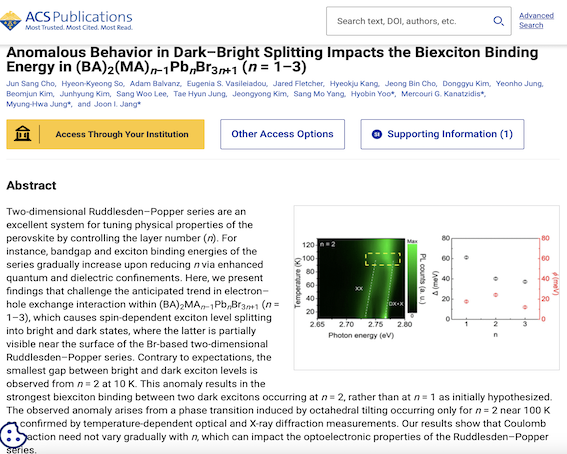
Two-dimensional Ruddlesden–Popper series are an excellent system for tuning physical properties of the perovskite by controlling the layer number (n). For instance, bandgap and exciton binding energies of the series gradually increase upon reducing n via enhanced quantum and dielectric confinements. Here, we present findings that challenge the anticipated trend in electron–hole exchange interaction within (BA)2MAn–1PbnBr3n+1 (n = 1–3), which causes spin-dependent exciton level splitting into bright and dark states, where the latter is partially visible near the surface of the Br-based two-dimensional Ruddlesden–Popper series. Contrary to expectations, the smallest gap between bright and dark exciton levels is observed from n = 2 at 10 K. This anomaly results in the strongest biexciton binding between two dark excitons occurring at n = 2, rather than at n = 1 as initially hypothesized. The observed anomaly arises from a phase transition induced by octahedral tilting occurring only for n = 2 near 100 K as confirmed by temperature-dependent optical and X-ray diffraction measurements. Our results show that Coulomb interaction need not vary gradually with n, which can impact the optoelectronic properties of the Ruddlesden–Popper series.
Impact of optimized growth conditions for magnetic phase transition and magnetic domain evolution in epitaxial FeRh thin film
FeRh undergoes a first-order magnetic phase transition, transitioning from a low-temperature antiferromagnetic state to a high-temperature ferromagnetic state around 370 K. This magnetic phase transition is profoundly affected by external parameters, such as composition and strain, which can be precisely controlled by varying growth conditions. Here, we present an investigation of FeRh thin films grown under various conditions, including annealing time and sputtering gun power. FeRh film grown at the optimal conditions yields a sharp and steep transition behavior, with maximal magnetization change between the antiferromagnetic and ferromagnetic phases. Magnetic force microscopy reveals that the optimal film displays directional domain growth, aligned with the crystallographic direction, while the non-optimal film shows random domain nucleation. Furthermore, we observe that the optimal film exhibits no significant correlation between surface morphology and magnetic domains, in contrast to the non-optimal film, where the surface morphology and magnetic domains are closely correlated. Our results highlight the critical interplay between growth conditions and film quality, emphasizing the importance of film optimization in the study of FeRh's magnetic phase transition. This comprehensive investigation provides valuable insights into the magnetic properties of FeRh, paving the way for future technological applications.
2D Weyl-Semimetal States Achieved by a Thickness-Dependent Crossover and Topological Phase Transition in Bi0.96Sb0.04 Thin Films
Despite theoretical expectations for 2D Weyl semimetals (WSMs), realizing stable 2D topological semimetal states experimentally is currently a great challenge. Here, 2D WSM states achieved by a thickness-dependent topological phase transition from 3D Dirac semimetal to 2D WSM in molecular-beam-epitaxy-grown Bi0.96Sb0.04 thin films are reported. 2D weak anti-localization (WAL) and chiral anomaly arise in the Bi0.96Sb0.04 films for thicknesses below ≈10 nm, supporting 2D Weyl semimetallic transport in the films. This is particularly evident from magnetoresistance (MR) measurements which show cusp structures at around B = 0, indicating WAL, and negative MR, typical of chiral anomaly, only for layers with thicknesses below ≈10 nm. The temperature dependencies of the dephasing length for various thicknesses are consistent with those of the MR. Analysis based on second harmonic generation, terahertz emission, Seebeck/Hall effects, Raman scattering, X-ray diffraction, and X-ray photoemission demonstrates that the Dirac- to Weyl-semimetal phase transition for films thinner than ≈10 nm is induced by inversion-symmetry breaking due to the lattice-mismatch strain between the Bi0.96Sb0.04film and substrate. The realization of 2D WSMs is particularly significant for applications in high-speed electronics, spintronics, and quantum computations due to their high mobility, chiral spin, and topologically-protected quantum qubits.
Berry paramagnetism in the Dirac semimetal ZrTe5
abstract : Dirac matters have attracted a lot of interest due to their unique band structure with linear band dispersions, which have great potential for technological applications. Recently, threedimensional Dirac and Weyl semimetals have invoked distinctive phenomena originating from a non-trivial Berry phase. In this study, we prepare single crystals of TixZr1-xTe5 with a highly anisotropic Fermi surface. Our detailed electrical transport measurements reveal that the crystals show the Lifshitz transition, and Ti doping induces a band shift. Further quantum oscillation analyses demonstrate that the TixZr1-xTe5 crystals are 3D Dirac semimetals. Additionally, we observed a minimum temperature-dependent magnetic susceptibility, which is close to a peak position of electrical resistivity. This observation is interpreted in terms of the Berry paramagnetism. Our finding paves the way to determine a band topology by magnetism and also provides a platform to apply the Berry magnetism to Dirac semimetals.
Orbit topology analyzed from π phase shift of magnetic quantum oscillations in three-dimensional Dirac semimetal
abstract: With the emergence of Dirac fermion physics in the field of condensed matter, magnetic quantum oscillations (MQOs) have been used to discern the topology of orbits in Dirac materials. However, many previous researchers have relied on the single-orbit Lifshitz–Kosevich (LK) formula, which overlooks the significant effect of degenerate orbits on MQOs. Since the single-orbit LK formula is valid for massless Dirac semimetals with small cyclotron masses, it is imperative to generalize the method applicable to a wide range of Dirac semimetals, whether massless or massive. This report demonstrates how spin-degenerate orbits affect the phases in MQOs of three-dimensional massive Dirac semimetal, NbSb2. With varying the direction of the magnetic field, an abrupt π phase shift is observed due to the interference between the spin-degenerate orbits. We investigate the effect of cyclotron mass on the π phase shift and verify its close relation to the phase from the Zeeman coupling. We find that the π phase shift occurs when the cyclotron mass is half of the electron mass, indicating the effective spin gyromagnetic ratio as gs = 2. Our approach is not only useful for analyzing MQOs of massless Dirac semimetals with a small cyclotron mass but also can be used for MQOs in massive Dirac materials with degenerate orbits, especially in topological materials with a sufficiently large cyclotron mass. Furthermore, this method provides a useful way to estimate the precise gs value of the material.
Emergence of the topological Hall effect in a tetragonal compensated ferrimagnet Mn2.3Pd0.7Ga
abstract: Topological spin textures such as magnetic skyrmions have attracted considerable interest due to their potential application in spintronic devices. However, there still remain several challenges to overcome before their practical application, for instance, achieving high scalability and thermal stability. Recent experiments have proposed a new class of skyrmion materials in the Heusler family, Mn1.4Pt0.9Pd0.1Sn and Mn2Rh0.95Ir0.05Sn, which possess noncollinear magnetic structures. Motivated by these experimental results, we suggest another Heusler compound hosted by Mn3Ga to overcome the above limitations. We fabricate Mn3-xPdxGa thin films, focusing on the magnetic compensation point. In Mn2.3Pd0.7Ga, we find a spin-reorientation transition around TSR = 320 K. Below the TSR, we observe the topological Hall effect and a positive magnetic entropy change, which are the hallmarks of a chiral noncollinear spin texture. By integrating all the data, we determine the magnetic phase diagram, displaying a wide chiral noncollinear spin phase even at room temperature. We believe that this compensated ferrimagnet shows promise for opening a new avenue toward chiral spin-based, high-density, and low-power devices.
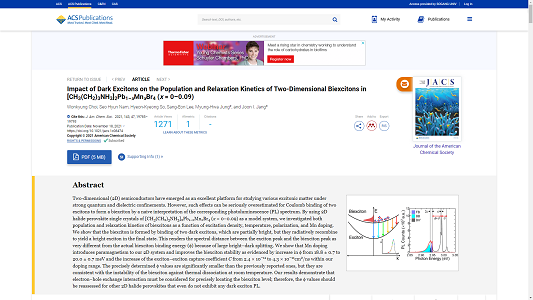
Impact of Dark Excitons on the Population and Relaxation Kinetics of Two-Dimensional Biexcitons in [CH3(CH2)3NH3]2Pb1- xMnx
abstract: Two-dimensional (2D) semiconductors have emerged as an excellent platform for studying various excitonic matter under strong quantum and dielectric confinements. However, such effects can be seriously overestimated for Coulomb binding of two excitons to form a biexciton by a naive interpretation of the corresponding photoluminescence (PL) spectrum. By using 2D halide perovskite single crystals of [CH3(CH2)3NH3]2Pb1–xMnxBr4 (x = 0–0.09) as a model system, we investigated both population and relaxation kinetics of biexcitons as a function of excitation density, temperature, polarization, and Mn doping. We show that the biexciton is formed by binding of two dark excitons, which are partially bright, but they radiatively recombine to yield a bright exciton in the final state. This renders the spectral distance between the exciton peak and the biexciton peak as very different from the actual biexciton binding energy (ϕ) because of large bright–dark splitting. We show that Mn doping introduces paramagnetism to our 2D system and improves the biexciton stability as evidenced by increase in ϕ from 18.8 ± 0.7 to 20.0 ± 0.7 meV and the increase of the exciton–exciton capture coefficient C from 2.4 × 10⁻¹¹ to 4.3 × 10⁻¹¹cm2/ns within our doping range. The precisely determined ϕ values are significantly smaller than the previously reported ones, but they are consistent with the instability of the biexciton against thermal dissociation at room temperature. Our results demonstrate that electron–hole exchange interaction must be considered for precisely locating the biexciton level; therefore, the ϕ values should be reassessed for other 2D halide perovskites that even do not exhibit any dark exciton PL.